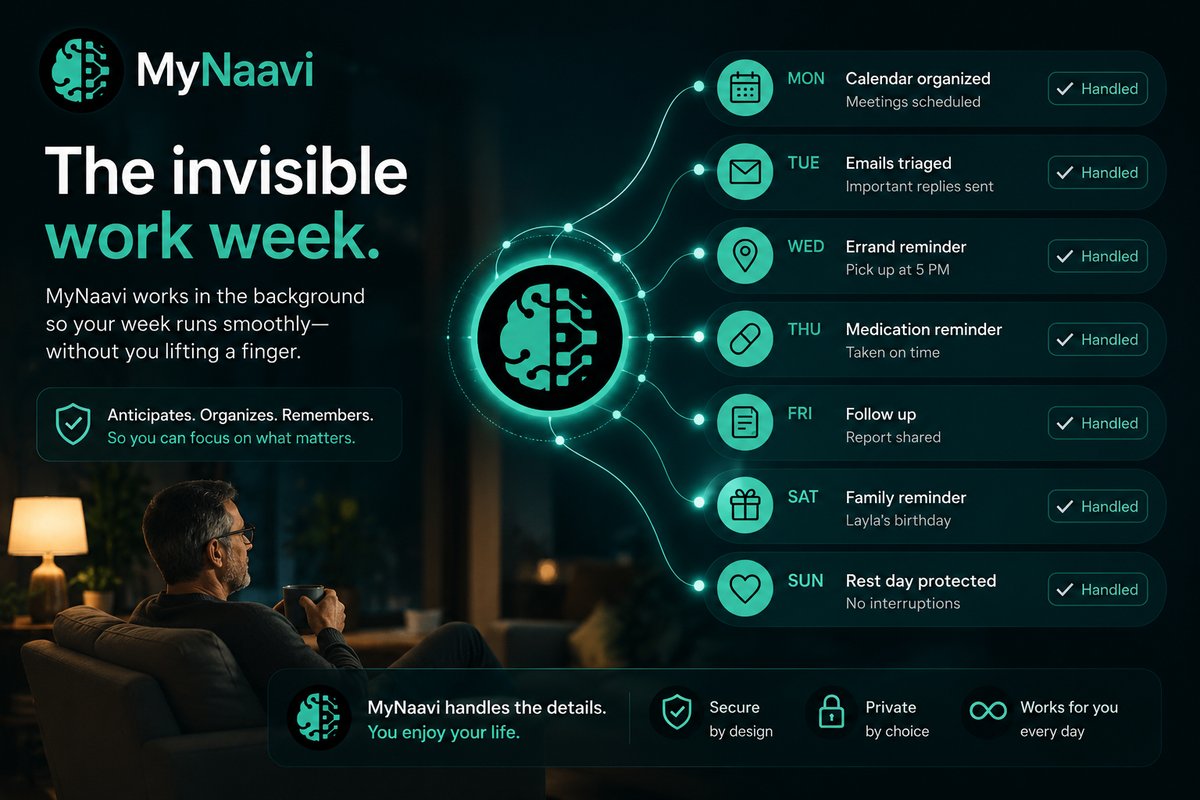
There is your job — the one with a salary and a title and meetings you can point to. And then there is the other one. The one that runs in parallel, every day, regardless of what else is happening.
Tracking the car warranty before it lapses. Following up with the contractor who gave you a quote three weeks ago and hasn't called back. Remembering what the specialist said about the medication before your GP asks at the next appointment. Catching the insurance renewal before it auto-renews at a rate you haven't agreed to. Keeping the list of things that need to happen before the trip, the move, the school year, the renovation.
None of this appears on any job description. None of it gets a performance review. And none of it ever stops.
It is not a productivity problem
The productivity industry has spent thirty years telling you the solution is a better system. A better calendar. A better to-do app. A better morning routine. If you could just get organized, the thinking goes, the invisible work would become manageable.
But the invisible work is not disorganized. It is unending. The moment you close one loop, three more open. The contractor calls back, but now you need to compare quotes. The insurance renews, but there is a new clause to read. The appointment is booked, but the referral requires a separate call.
"The bottleneck is not capacity to do work. It is capacity to notice when work needs to be done."
No app fixes that. An app is something you open. The invisible work is everything that happens while you are doing something else entirely — in a meeting, in the car, in the middle of a conversation with someone you love.
What the invisible work actually costs
The visible cost is the things that slip. The warranty that expires two months before the part fails. The renewal that auto-renews at the higher rate because the reminder fired at the wrong time. The follow-up that never happened because it lived only in your head and your head was full.
The invisible cost is harder to name. It is the low-grade vigilance that never quite turns off. The part of your attention that is always running a background check — what am I forgetting, what needs to happen, what is about to fall through? That vigilance is not free. It takes something from every conversation, every quiet moment, every hour that should have been rest.
Most people carry this so long they stop noticing it. They call it being responsible. They call it being on top of things. But being on top of things, for most adults, means a constant low-level effort that has no name and no end.
The colleague you always needed
Imagine a colleague — not an assistant, not a service — who sits alongside you and watches the corners. Who notices the warranty is expiring before you think to check. Who remembers what the doctor said before you have to ask the doctor again. Who catches the renewal, flags the follow-up, surfaces the list item at the moment you are walking past the store.
Not a bot that answers questions. A colleague who comes to you with the right thing at the right time, already knowing the context, and asks for one decision rather than ten.
You do not have to check. You do not have to remember. You do not have to run the background process. You just live your life, and the invisible work gets done alongside it.
That is what MyNaavi is for. Not to replace the work — you still make the decisions. But to carry the watching, the noticing, the surfacing, so the part of your brain that was always on call can finally rest.
The invisible work week does not have to be yours alone.
Let MyNaavi watch the corners.
Call the demo line — 1-888-91-NAAVI — from any phone.
No app, no account, no setup.
MyNaavi is free on Google Play.