Before Robert and Marie leave for a concert, he checks the venue website to confirm the start time, opens his maps app, calculates mentally when they should leave, tells Marie 7:15, makes a note in his calendar, and reminds himself to set the navigation before they go out the door.
That is five steps, three apps, and one mental calculation — every single time. Not because Robert is not capable of handling it. Because nothing connects it for him.
This is the problem that automation, on its own, cannot solve. And understanding why is important for anyone building technology meant to genuinely help.
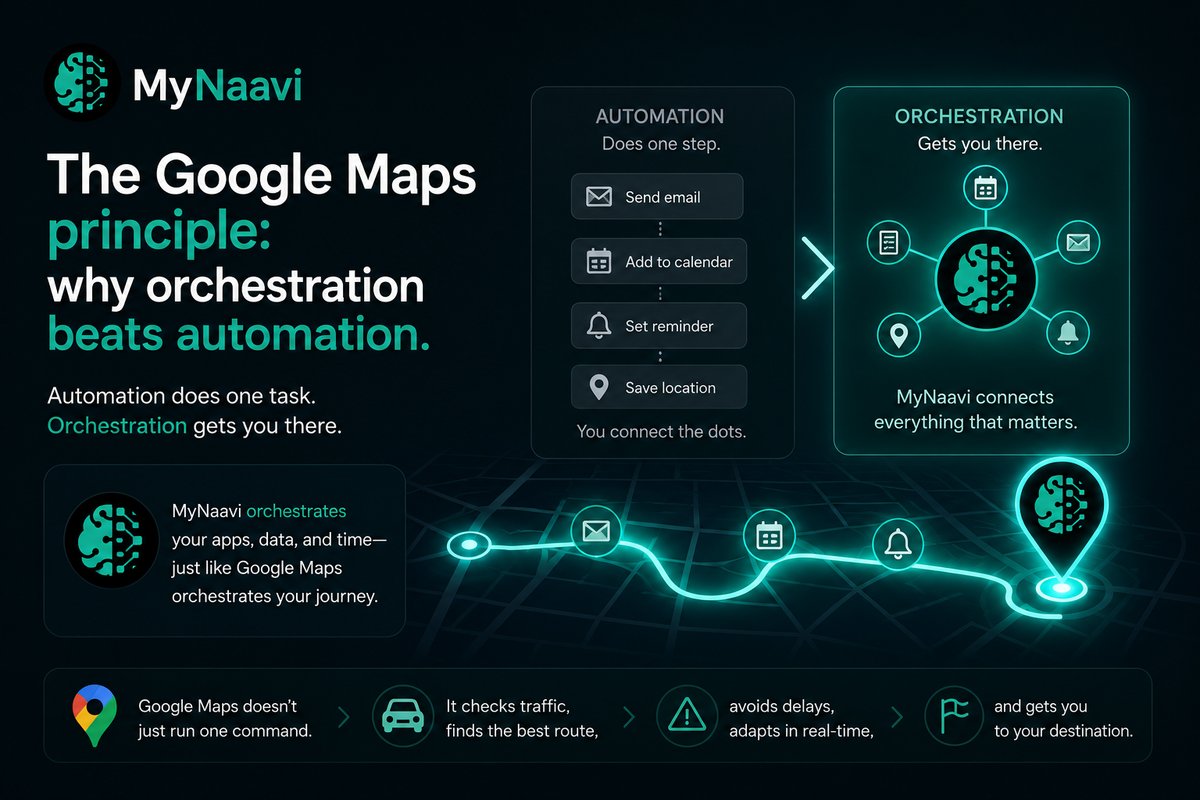
Automation answers the question you asked
Automation is powerful. A reminder fires at 6:45. A calendar event is created. A navigation shortcut is saved. Each of these helps. None of them connect.
The reminder at 6:45 does not know about the traffic on Tuesday evenings. The calendar event does not know that Robert tends to lose track of time when his son calls. The navigation shortcut does not know the concert starts at 7:30 and the closest parking was the garage two blocks east last time.
Automation answers the question it was programmed to answer. It has no awareness of the context surrounding that question — the other tools, the other commitments, the patterns of a specific person's actual life.
"Automation is a tool that does one thing well. Orchestration is a layer that makes everything work together."
The Google Maps insight
Google Maps does not own a single road. It has no cars, no traffic lights, no infrastructure. It built none of the roads it navigates. And yet it controls the experience of driving for hundreds of millions of people every day.
The value was never in the roads. It was in the navigation layer — the intelligence that sits above all the infrastructure, connects it, and guides the person through it. That layer is where all the compounding value lives. Everything else is just the underlying network.
Most people who use Google Maps do not think about this. They just experience a drive that feels easier than it used to be. The intelligence is invisible. The benefit is not.
The same principle applied to a life
Robert already has the tools. A calendar. A notes app. A voice recorder. A smart home assistant. A health portal. He has built a real ecosystem, thoughtfully assembled over years. Each tool does its job well.
What he does not have is the navigation layer above all of them. The intelligence that connects what his calendar knows to what his maps app knows, that surfaces the note he made three months ago at exactly the moment it becomes relevant, that handles the departure calculation so he never has to.
MyNaavi does not replace any of Robert's tools. MyNaavi becomes the orchestration layer above all of them — connecting what they each know, learning who Robert is across all of it, and acting proactively so he never has to be the one doing the connecting.
Robert keeps every tool he already uses and trusts. MyNaavi makes them work together for the first time. The tools are the roads. MyNaavi is the navigation.
Why this matters beyond the analogy
The orchestration frame changes what success looks like. Automation succeeds when a task is completed. Orchestration succeeds when a person feels that their life is flowing — when the invisible effort of connecting everything disappears and what remains is simply living.
That is harder to measure. It is also what actually matters.
Before the concert, Robert and Marie had a comfortable dinner. He already knew what time they needed to leave. Navigation was ready. He was present — not because he had done the work in advance, but because the work had been done for him, invisibly, by the layer sitting above his life.
That is orchestration. Not one thing done better. Everything working together.
Be among the first.
Call the demo line — 1-888-91-NAAVI — from any phone.
No app, no account, no setup.
MyNaavi is free on Google Play. It is in early days — install it, and tell us what works and what does not.