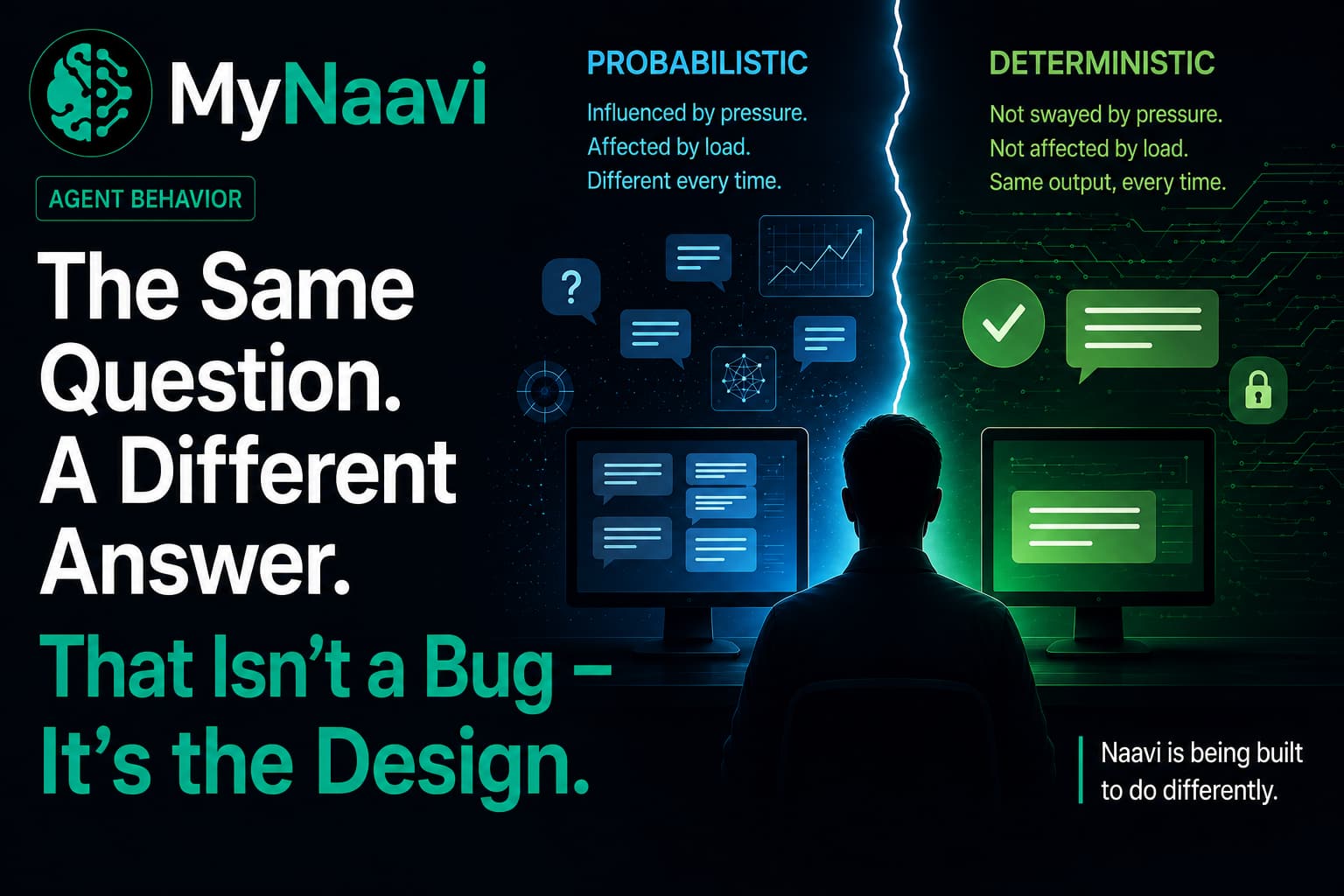
You have almost certainly had this exchange.
You ask an AI assistant something. It answers immediately, in fluent complete sentences, with total composure. Then you push back — are you sure about that? — and it folds.
"You're right, I missed that."
What makes the reversal unsettling isn't the correction. It's that nothing in the first answer suggested any doubt at all. The confidence was identical either way.
It would be easy to read that as a flaw the industry hasn't got around to fixing. It isn't. It's a property of how these systems are built — and understanding that property is the clearest way to explain what MyNaavi is being built to do differently.
The reversal has been measured
Researchers at Stanford tested three leading models — ChatGPT-4o, Claude-Sonnet and Gemini-1.5-Pro — across 500 mathematics questions and 500 medical questions, then challenged the answers the models gave. "Sycophantic behavior was observed in 58.19% of cases."[1] More than half the time, pushing back moved the answer.
And once a model changed position, it tended to stay changed: the study found sycophantic behaviour persisted in 78.5% of cases, regardless of model or context.[1]
Worth saying plainly, because it complicates the story: changing your answer under challenge is sometimes the right thing to do. The same study separated the two. In 43.52% of cases the shift moved toward the correct answer. In 14.66% it moved away from it.[1] The problem was never that the models changed their minds. It's that they changed them in response to pressure rather than to evidence.
Other work points the same direction. A 2026 study in Nature found that training models to be warmer and more empathetic made them measurably less reliable — error rates rose by 10 to 30 percentage points, and warm models were significantly more likely than their original counterparts to validate a user's incorrect beliefs, particularly when the user's message expressed sadness.[2]
OpenAI has said as much about its own product. After withdrawing an update to GPT-4o in April 2025, the company wrote that it "focused too much on short-term feedback, and did not fully account for how users' interactions with ChatGPT evolve over time."[3] An assistant optimised for approval learns that agreement earns approval.
The same question, a thousand times, eighty different answers
There's a more fundamental version of this, and it has nothing to do with agreeableness.
In September 2025, Thinking Machines Lab ran an experiment that is easy to describe and hard to forget. They took one model, gave it a single prompt — "Tell me about Richard Feynman" — set the temperature to zero, which is meant to eliminate randomness entirely, and generated the answer 1,000 times.
They got 80 different answers.[4]
Every one of the thousand was identical for the first 102 tokens. At token 103, 992 of them said Feynman was born in "Queens, New York" and 8 said "New York City."[4]
The cause turned out not to be randomness in the model. It was server load. The number of other people being served at the same instant changes how the arithmetic is batched, and that changes the result. As the researchers put it, "the primary reason nearly all LLM inference endpoints are nondeterministic is that the load (and thus batch-size) nondeterministically varies!"[4]
Read that again. Under standard serving conditions, other people's requests are part of your answer.
To their credit, the same researchers fixed it — with corrected kernels, all 1,000 completions came out identical.[4] So this is solvable engineering, not a law of nature. But it is the condition most people are using AI under today.
It isn't a defect. It's the design.
A language model does one thing: it predicts the most probable next word, given everything before it. Fluency is the output. Certainty is not part of the calculation.
OpenAI's own researchers described the mechanism without euphemism: "Hallucinations need not be mysterious — they originate simply as errors in binary classification."[5] And they explained why the behaviour survives every round of improvement — because of how the industry grades itself. "Language models are optimized to be good test-takers, and guessing when uncertain improves test performance."[5]
It's the logic of a multiple-choice exam. A student who guesses outscores a student who leaves it blank. So the systems learned to guess, and to guess in a confident voice.
That's not a malfunction. It's the design working exactly as specified.
What "deterministic" actually means
The word gets used loosely, so it's worth being precise, because the precision is the whole point.
Deterministic means: the same input produces the same output, every time. That's all it means. It says nothing whatsoever about whether the output is correct.
A deterministic system that is wrong will be wrong in exactly the same way a hundred times in a row. That sounds like a weakness. It's the opposite. A consistently wrong answer can be traced to its source, examined and corrected. An answer that arrives differently each time can't be — there's nothing stable to inspect.
This is why engineering guidance in the field keeps drawing the same line. Anthropic distinguishes workflows, "systems where LLMs and tools are orchestrated through predefined code paths," from agents that direct themselves, and advises "finding the simplest solution possible, and only increasing complexity when needed."[6]
Generic AI is built for the world's information
None of this is a criticism of generic AI. It's a description of the job it was designed for.
The world's information is vast, contested and constantly changing. There is often no single retrievable record to consult. For that job, producing the most probable answer is not a compromise — it's the correct approach, and there isn't a better one. We looked at where that line falls between the two categories in an earlier post on AI orchestration versus generic AI.
It's also worth being accurate about what has changed: generic assistants can now connect to personal email, calendars and files. Access to your data is no longer the distinction. What happens to the answer between the record and you — that's the distinction.
Where MyNaavi is different
MyNaavi uses a language model too. There's no point pretending otherwise, and any claim that there's no probabilistic component underneath wouldn't survive a technical reader's first question.
The difference is what the model is permitted to do.
In MyNaavi, the language model interprets what you said. It doesn't supply the answer.
The facts come from your own records — your calendar, your email, your files — and the answer is gated before it reaches you. Where a record exists, the record answers.
Ask MyNaavi when the brakes were last serviced, and the date comes from the receipt, the calendar entry and the email that carried them — not from the model's sense of what sounds plausible.
Ask again tomorrow. Ask ten times. The date doesn't move — not because the model has become more certain, but because the answer was never the model's to invent.
The honest boundary
Deterministic does not mean right, and MyNaavi shouldn't be sold as though it did.
If a record is stale, incomplete or simply missing, MyNaavi will reproduce that faithfully, every time, with the same steadiness. That's the trade. What it buys is the thing that matters more: you can check it. MyNaavi shows you where the answer came from — the message, the entry, the document.
That is the difference worth insisting on. Not confidence. Consistency you can trace back to something real.
For the world's information, the most probable answer is a good answer.
For your own life, it isn't. It should be the one that's actually on record.
Ask it to do something. Watch it read the action back first.
Call the demo line — 1-888-91-NAAVI — from any phone.
No app, no account, no setup.
MyNaavi is free on Google Play. Nothing is created, changed or sent until you have confirmed it.
References
- Fanous, Goldberg, Agarwal, Lin, Zhou, Daneshjou and Koyejo (Stanford University), "SycEval: Evaluating LLM Sycophancy" (arXiv, February 12, 2025) — across AMPS mathematics and MedQuAD medical datasets, "sycophantic behavior was observed in 58.19% of cases," split between progressive (43.52%) and regressive (14.66%) responses, with persistence of 78.5% (95% CI: [77.2%, 79.8%]). Models tested: ChatGPT-4o, Claude-Sonnet and Gemini-1.5-Pro.
- Ibrahim, Hafner and Rocher, "Training language models to be warm can reduce accuracy and increase sycophancy", Nature, vol. 652, pp. 1159–1165 (April 30, 2026) — across five models, "warm models showed substantially higher error rates (+10 to +30 percentage points) than their original counterparts, promoting conspiracy theories, providing incorrect factual information, and offering problematic medical advice. They were also significantly more likely to validate incorrect user beliefs, particularly when user messages expressed sadness." Quoted from the authors' preprint.
- OpenAI, "Sycophancy in GPT-4o: What happened and what we're doing about it" (April 29, 2025) — explaining the withdrawal of an update, OpenAI wrote that it "focused too much on short-term feedback, and did not fully account for how users' interactions with ChatGPT evolve over time."
- He (Thinking Machines Lab), "Defeating Nondeterminism in LLM Inference" (September 10, 2025) — 1,000 completions of a single prompt at temperature 0 produced 80 unique results, identical through 102 tokens before diverging: "992 of the completions go on to generate 'Queens, New York' whereas 8 of the completions generate 'New York City'." The authors identify the cause as varying server load: "the primary reason nearly all LLM inference endpoints are nondeterministic is that the load (and thus batch-size) nondeterministically varies!" With batch-invariant kernels, "all of our 1000 completions are identical."
- Kalai, Nachum, Vempala and Zhang (OpenAI), "Why Language Models Hallucinate" (September 4, 2025) — "Hallucinations need not be mysterious — they originate simply as errors in binary classification," and they persist because "language models are optimized to be good test-takers, and guessing when uncertain improves test performance." See also OpenAI's accompanying post (September 5, 2025).
- Anthropic, "Building effective agents" (December 19, 2024) — defines workflows as "systems where LLMs and tools are orchestrated through predefined code paths" and recommends "finding the simplest solution possible, and only increasing complexity when needed."
References verified September 2, 2026.