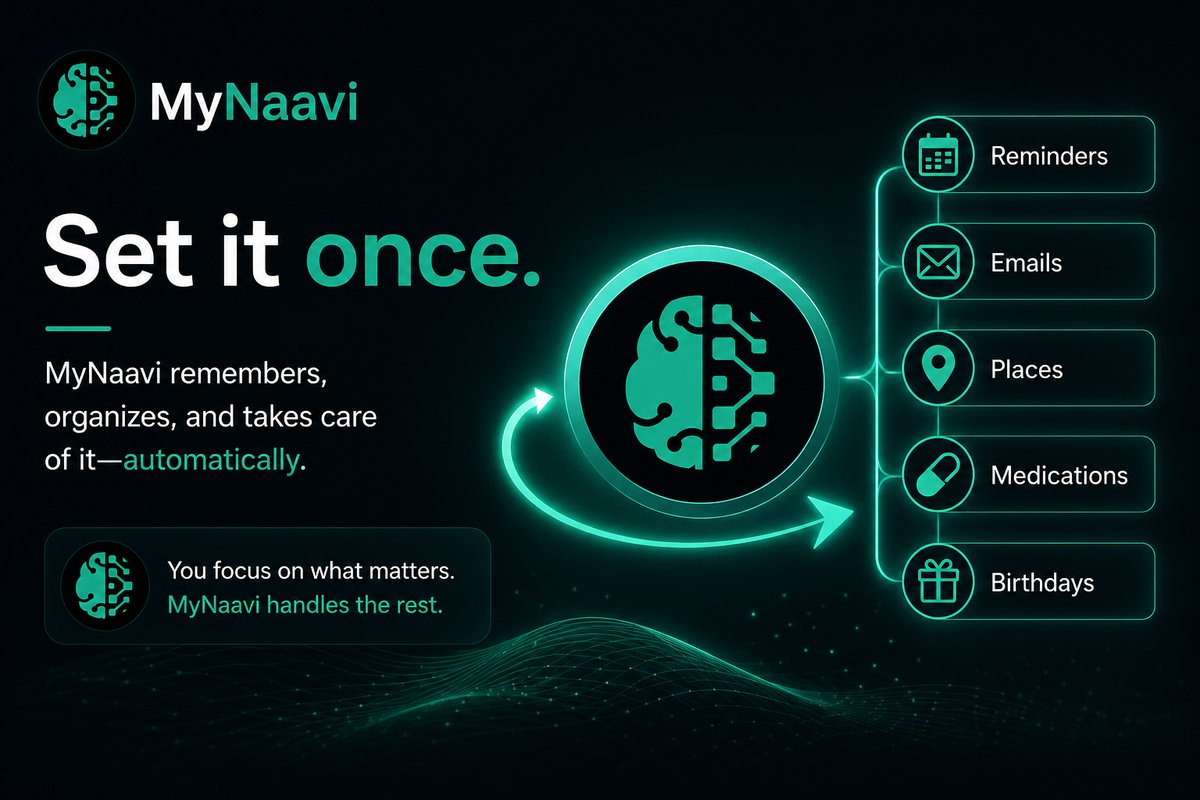
Every tool you have ever used to manage your life has the same fundamental flaw: it requires you to come back to it.
You set a reminder. The reminder fires. If you are not ready — if you are in a meeting, in the car, in the middle of something — you dismiss it. It is gone. The thing it was reminding you about is still there, but the thread has been cut. You have to rebuild it from scratch.
You write something in a notes app. The note sits there, waiting to be found. You have to remember that the note exists, remember which app you put it in, remember enough of the words to search for it. The note is passive. It will never come to you. You always have to go back to it.
This is the design assumption baked into every productivity tool ever made: you are the one who will follow up. The tool holds the thing. You do the remembering.
The problem with reminders
A reminder is a single-use object. It fires once. If the timing is wrong, it is wasted. If the context is wrong — if you see the reminder for the dentist appointment while you are standing in line at a grocery store with your hands full — the reminder does not adapt. It does not wait for a better moment. It fires and disappears.
The deeper problem is that most of what you want to track is not an event. It is an ongoing intention. Watch my inbox for appointment letters. Alert me when I arrive at the pharmacy. Remind me to return Tom's ladder next time I'm heading that way. These are not single moments with a fixed time. They are standing instructions — things you want to remain true until they are no longer needed.
"A reminder asks you to remember. An intention asks you to trust — and then get out of your own way."
No reminder app can hold an intention. It can only hold a moment. And moments expire.
What sticky means
When you tell a thoughtful colleague something once — let me know if anything comes in from the Toronto client — you do not expect to repeat yourself the next day. You do not expect to set a recurring reminder to ask them if anything came in. You told them. The intention is now theirs to carry. You trust them to bring it to you when it is relevant.
That is what we mean by sticky. The instruction does not expire when it goes unneeded for a week. It does not require you to re-enter it every time you remember it. It lives with MyNaavi until the condition is met — and then MyNaavi comes to you, not the other way around.
Watch my inbox for when registration opens for the Thursday pottery class. Seven weeks later, on a Monday morning, MyNaavi says: registration opened an hour ago. The Thursday evening session — the one you took last spring — still has two spots left. Want me to hold one?
You did not check the community centre's website every few days. You did not set a calendar reminder to "maybe check pottery registration." You told MyNaavi once, in passing, and seven weeks later it came back with the window found and a decision ready for you.
One decision at a time
There is a reason most of us do not act on things the moment we think of them: the thought arrives at the wrong time, without the right context, and requires effort that we do not have available at that moment.
You think of the ladder while you are loading groceries into the car. You cannot drive it over now. You make a mental note. You forget. Three weeks later, you remember, feel vaguely bad, and by now it feels strange to just show up with it out of nowhere.
The alternative is not a better reminder. The alternative is arriving at the moment you do have available — a free Saturday morning — and being presented with: You've had Tom's ladder since March. You're both around this morning. Want me to text him you'll drop it by at ten?
One decision. Not: remember the thing, find the time, work up to it. One decision: yes or no.
This is what it means to set something once and trust it. Not that the work disappears — you still make the call. But that the work of noticing, remembering, surfacing, and preparing is no longer yours to carry.
The shift
The tools you have now were built on the assumption that you will manage them. You will create the reminders, check the notes, return to the app, follow up on yourself. The burden of continuity is always yours.
MyNaavi is built on the opposite assumption: that you should be able to say something once, the way you would tell a trusted colleague, and trust that it will carry forward without you having to hold it.
Say it once. Then let it go. Come back only when something needs your decision — not your attention, not your memory, not your follow-through. Just your decision.
That is the whole idea. And it turns out to be enough to change how a day feels.
Tell MyNaavi one thing. Trust it to come back.
Call the demo line — 1-888-91-NAAVI — from any phone.
No app, no account, no setup.
MyNaavi is free on Google Play.