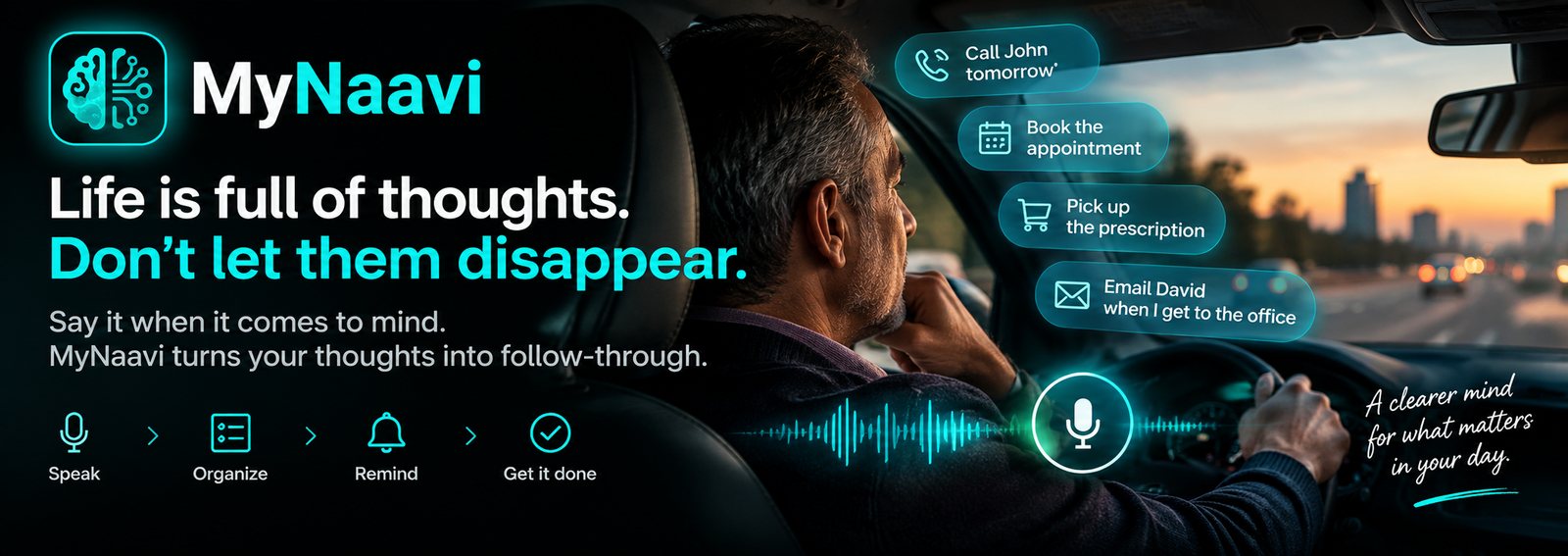
When we started designing MyNaavi, voice was not something we added later because voice assistants had become popular.
Voice was part of the idea from the first day.
The reason had little to do with the novelty of voice technology. It came from a more fundamental question:
Where are you when you remember the things you need to do?
You may be driving home when you remember the person you promised to call. You may suddenly remember the email you said you would send. You may think about an appointment you need to make, something you need to pick up, or something important you want to do when you get home.
And then you arrive.
The environment changes. Someone talks to you. Another task demands your attention. You move into the next part of your day.
And sometimes the thought is gone.
This was important to the original philosophy behind MyNaavi. But it is not simply our observation. Research helps explain both why the car can become an important thinking space and why intentions formed in one context can be vulnerable when we move into another.
The commute is not simply transportation
Researchers have studied what happens psychologically in the space between work and home.
A 2021 study published in Organization Science, “Between Home and Work: Commuting as an Opportunity for Role Transitions”, describes commuting as a “liminal role transition” between our home and work roles. Across three field studies involving 1,736 people, the researchers examined how people use commuting time to transition psychologically between those different parts of their lives. One of the behaviors they studied was what they call “role-clarifying prospection” — thinking ahead about the role a person is about to enter.[1]
In other words, the commute isn’t necessarily mentally empty time. It can be a time when we think ahead.
Other researchers have developed this idea further. McAlpine and Piszczek’s research on the work-to-home commute describes commuters as occupying a “liminal space” — temporarily between work and home rather than fully participating in either one. Their framework examines how this in-between period can provide an opportunity for psychological transition, detachment and recovery.[2]
That description is remarkably close to something many of us experience without ever giving it a name.
We are between two worlds. And sometimes, in that space between them, our minds have room to process what happened today and what needs to happen next.
The car can become a personal space in-between
Organizational researcher Harriet Shortt has studied what she calls “transitory dwelling places.” In her peer-reviewed paper “Liminality, Space and the Importance of ‘Transitory Dwelling Places’ at Work”, Shortt examines how spaces that appear to be merely transitional can acquire personal and psychological significance.[3] She later applied these ideas specifically to her own commute by car, describing the journey between work and home as a space where she could transition between roles, reflect and decompress.
Transportation researchers Juliet Jain and Glenn Lyons approached the question from another direction in “The Gift of Travel Time”. Rather than assuming that travel time is simply wasted time that should always be minimized, they examined what people actually experience and do during travel. Their research identifies, among other things, the value of transition time — the psychological movement between the activities and identities associated with different destinations.[4]
So the idea of the commute as an important psychological space is not something MyNaavi needs to invent. Researchers have been studying different aspects of it for years.
The automobile itself is changing
There is an interesting parallel happening in automotive design.
The expression “third place” requires some care. Sociologist Ray Oldenburg originally used it to describe informal social places outside home and work — places such as cafés, pubs and other community gathering places. A private automobile therefore isn’t Oldenburg’s original “third place.”
But automotive designers have increasingly borrowed similar language as they rethink the vehicle interior. The cabin is no longer being designed purely as a mechanical cockpit. Increasing attention is being given to acoustic isolation, lighting, seating, climate, personalization and wellbeing — treating the automobile as an environment in which people spend a meaningful part of their lives.
This reinforces an important point for MyNaavi: the time between destinations is itself part of life.
And what interests us most isn’t simply what people do in that space. It is what they think about there.
“I need to remember to do that”
Memory researchers have a term for something we all experience every day: prospective memory.
Prospective memory is our ability to remember an intention that needs to be carried out in the future. It is different from remembering what happened yesterday. It is remembering:
- I need to call someone later.
- I have to send that document.
- I need to stop somewhere on the way home.
- I have an appointment tomorrow.
- I promised I would do something.
Rebekah Smith’s review, “Prospective Memory in Context”, examines how we remember to perform intended actions when there is a delay between forming an intention and having the opportunity to carry it out.[5] That describes a surprisingly large part of everyday life.
And it explains something important about thoughts that occur during a commute. At the moment the thought occurs, you haven’t forgotten anything. You know perfectly well: I need to call David.
The real question is: will you remember that intention later, when you can actually do something about it?
Then you arrive
This is where another part of memory research becomes particularly relevant. Interruptions matter. Context matters. And what happens between forming an intention and carrying it out matters.
Dodhia and Dismukes examined this problem in “Interruptions Create Prospective Memory Tasks”. Their research helps explain why people sometimes fail to resume an intended activity after interruption. Attention may be diverted, new demands compete for attention, and the environment may fail to provide the cue necessary to bring the intention back to mind.[6]
Experimental research by Schaper and Grundgeiger examined this further in “The Effect of Different Distractions on Remembering Delayed Intentions”. Their experiments examined multitasking, interruptions and context changes and how they affect people’s ability to remember delayed intentions.[7]
Earlier research by McDaniel and colleagues, “Delaying Execution of Intentions: Overcoming the Costs of Interruptions”, found significant costs to prospective-memory performance following interruptions. Particularly interesting for the problem MyNaavi is trying to solve, their experiments also showed that an external mnemonic could help overcome those costs.[8]
Now consider an ordinary drive home. During the drive: “I have to call David.”
Then you arrive. You park. Get out. Walk inside. Someone asks you a question. Dinner needs attention. An email appears.
The environment in which the thought occurred has disappeared, and another context has taken over.
Research does not tell us that everyone forgets what they think about in a car. But it gives us a well-established cognitive framework for understanding something many people recognize from their own lives:
A thought can feel important and completely clear when it occurs — and disappear when attention and context move on.
This is where MyNaavi started
That brings us back to the original design decision.
Traditional productivity software usually enters the process after you decide to use the software. You remember something. You take out your phone. Unlock it. Find an application. Open the right screen. Decide where the information belongs. Type it. Save it.
But prospective-memory research suggests that the critical moment begins earlier: the moment the intention is formed.
And that moment does not necessarily happen while you are sitting at a keyboard. It happens while life is already happening.
That is why MyNaavi was designed from the first day to be voice-first. Not because voice is fashionable. Not because typing is obsolete. And not because every interaction should happen through voice.
Voice is the solution to where the problem happens.
When a thought occurs while your hands and eyes are occupied, requiring you to stop, navigate software and type creates friction between having the thought and preserving the intention.
Speech offers a much more natural bridge:
“Remind me tomorrow to call David.”
“When I get to the office, remind me to give Sarah the document.”
“I need to pick up my prescription.”
The person no longer has to depend entirely on prospective memory to carry that intention forward.
Voice is only the beginning
This distinction is important. If MyNaavi simply recorded what you said, we would have built a voice recorder.
The objective isn’t just capture. It is follow-through.
The thought needs to become something useful — a reminder, an activity, a calendar action, a communication, or something connected to the time, place or situation in which it needs to return to you.
That is why we think about the process as:
Thought → Capture → Organize → Follow-through
Voice makes the transition from thought to capture easier. MyNaavi is designed to help with what comes afterward.
A word about driving
None of this means that voice interaction makes distracted driving safe.
The U.S. National Highway Traffic Safety Administration’s Distracted Driving guidance distinguishes between visual, manual and cognitive distraction. Hands-free does not automatically mean distraction-free.[9]
That distinction matters. The MyNaavi philosophy isn’t “do more things while you drive.” It is almost the opposite.
Driving deserves your attention. Where voice interaction is appropriate and legally permitted, the objective should be to minimize the interaction required to preserve an important thought, not turn the car into another office.
The car helped us see a much bigger problem
The car is perhaps the clearest illustration, but the underlying problem is much broader.
We remember things while walking. While cooking. After talking with someone. Between meetings. After leaving a doctor’s appointment. While doing something completely unrelated to the thing we suddenly remember.
Our intentions don’t conveniently wait until the appropriate software is open.
That is the philosophy that shaped MyNaavi from the beginning. Most software waits for you to come to it. We wanted to start earlier — at the moment something important crosses your mind.
That is why MyNaavi was voice-first from day one. MyNaavi is voice-first because of where the problem happens.
And perhaps the real problem isn’t remembering something for a few seconds. It is making sure that something important that crosses your mind survives the transition into whatever comes next.
References
- Jachimowicz, J. M., Cunningham, J. L., Staats, B. R., Gino, F., & Menges, J. I. “Between Home and Work: Commuting as an Opportunity for Role Transitions.” Organization Science, 32(1), 64–85.
- McAlpine, K. L., & Piszczek, M. M. “Along for the Ride Through Liminal Space: A Role Transition and Recovery Perspective on the Work-to-Home Commute.” Organizational Psychology Review.
- Shortt, H. “Liminality, Space and the Importance of ‘Transitory Dwelling Places’ at Work.” Human Relations, 68(4), 633–658.
- Jain, J., & Lyons, G. “The Gift of Travel Time.” Journal of Transport Geography, 16(2), 81–89.
- Smith, R. E. “Prospective Memory in Context.” Psychology of Learning and Motivation, Vol. 66, 211–249.
- Dodhia, R. M., & Dismukes, R. K. “Interruptions Create Prospective Memory Tasks.” Applied Cognitive Psychology, 23(1), 73–89.
- Schaper, P., & Grundgeiger, T. “The Effect of Different Distractions on Remembering Delayed Intentions.” Memory, 26(2), 154–170.
- McDaniel, M. A., Einstein, G. O., Graham, T., & Rall, E. “Delaying Execution of Intentions: Overcoming the Costs of Interruptions.” Applied Cognitive Psychology, 18(5), 533–547.
- National Highway Traffic Safety Administration. “Distracted Driving.”