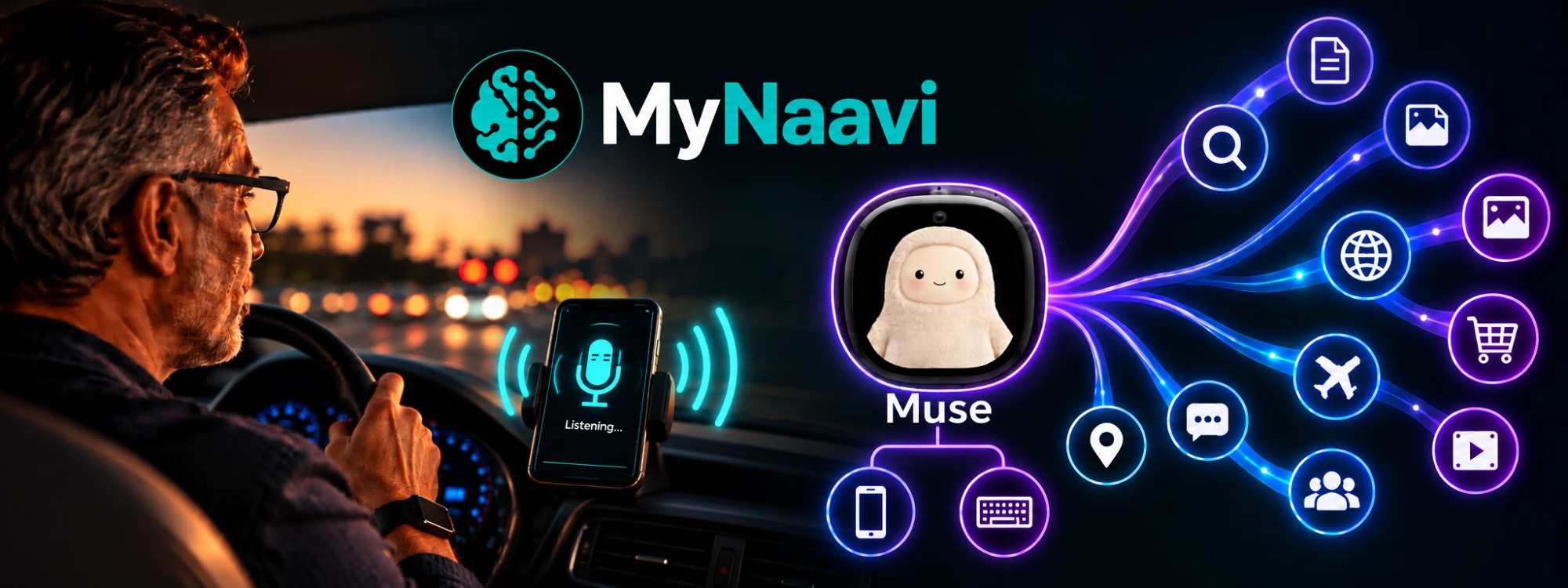
A few days ago, I wrote about what Meta's launch of Muse tells us about where personal AI is headed.
I tried to be careful about the comparison. Meta and MyNaavi operate at radically different scales, and the two products are making some very different choices about how personal AI should work.
But after publishing the article, a simple thought occurred to me:
Why am I doing all the comparing? Why not ask Muse?
So I did.
I asked Muse to compare itself with MyNaavi. I asked it to send its answer by email, and it did. [2]
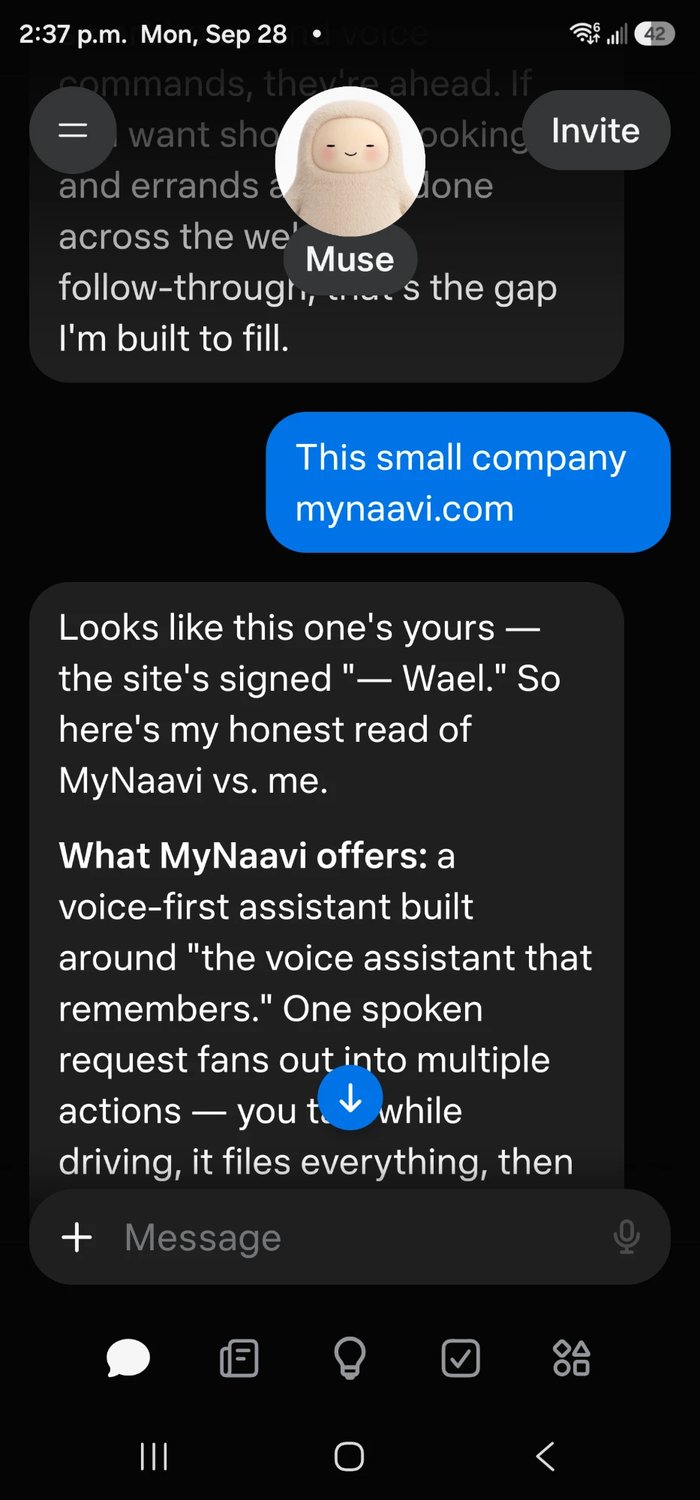
Muse knew exactly who was asking. Its reply opened with: "Looks like this one's yours — the site's signed '— Wael.'" So this wasn't Muse describing MyNaavi to a stranger. It was Muse answering MyNaavi's founder directly.
One thing to be clear about before going further: Muse hadn't used MyNaavi itself. What it knows about us comes from public information, and there is a good deal of it out there: our website, our LinkedIn, and our YouTube channel, which has recorded live demos of MyNaavi at work.
What came back was more interesting — and more balanced — than I expected.
Muse didn't declare a winner. Instead, it described two different approaches to personal AI.
What Muse said MyNaavi does
Muse began by describing MyNaavi as:
"A voice-first assistant built around 'the voice assistant that remembers.'"
It picked up on something fundamental to the way we've designed MyNaavi: one spoken request can turn into several actions, and those actions can surface again when they're relevant.
Muse specifically mentioned examples such as retrieving information across email, calendar and files, proactively calling you with a reminder, and capturing a real-world interaction such as a doctor visit and turning it into calendar items, reminders and a summary email.
That's a reasonably good description of what we are building.
But the next section was the one that caught my attention.
Muse: "Where it's ahead of me"
Those are Muse's words, not mine.
Muse identified three areas.
First, voice-first interaction:
"You just call and talk — designed for the car, the waiting room, the moments your hands are busy. I'm text-first on your account."
That's important to me because MyNaavi was voice-first from the beginning.
We didn't start with a chatbot and later add voice as another interface. We started with the problem of remembering something while you're living your life — driving, walking, waiting somewhere, or doing something with your hands — and being able to act on that thought immediately.
Second, Muse pointed to something very simple:
"It rings you."
MyNaavi can proactively call you.
Muse's description was even better:
"Proactive phone calls ('don't forget the gift') hit differently than a push notification."
That's exactly the distinction we've been exploring. Sometimes the problem isn't whether a system can create a reminder. The problem is whether that reminder reaches you in a way that's difficult to overlook.
Third, Muse identified real-world recording — for example, capturing a doctor visit and extracting follow-up actions from the conversation.
Muse described that limitation from its own perspective:
"Real-world recording. Transcribing a doctor visit and extracting actions from it is something I can't do — I have no microphone on the world."
That's a fascinating phrase: "no microphone on the world."
It gets very close to why we made voice and real-world capture central to MyNaavi.
Meta's answer to that gap is new hardware. At Connect, it unveiled Muse Charm, a pocket-sized device built for talking to Muse, with more details promised later this year. It also announced that Muse is coming to its AI glasses, with more than 100 styles of AI glasses expected by the end of the year. In Meta's own words, it is building "a whole family of devices" to connect with its agents. [1] None of that is a setting you switch on. It's hardware you have to buy, charge and carry.
MyNaavi has no special hardware, and doesn't need any. Its microphone on the world isn't a device at all. It's the voice call itself.
You reach MyNaavi with an ordinary call: from any phone, including one that isn't yours (using your own PIN), or from any app that can place a phone call. There's no app to open first. You don't even need your own phone.
That difference matters to me. Even the best dedicated device ties you to that device. If it's in a drawer, out of battery or left at home, so is your assistant. We don't believe your personal AI should depend on a piece of hardware.
The call is the interface, not the device.
Then Muse explained where it is ahead
This is where I found the comparison particularly credible.
Muse didn't just identify MyNaavi's strengths. It was very clear about its own.
It described the first as "Breadth of action."
Muse pointed to capabilities such as browsing any website with a login, completing shopping checkout, booking travel, building documents and web apps, and managing social accounts.
Then it summarized the distinction:
"MyNaavi's actions center on personal data and reminders; mine extend across the web."
Muse also identified the advantage of Meta's broader ecosystem: connected services, wallet payments, artifacts and scheduled background work.
That is an enormous surface, backed by an enormous company.
MyNaavi isn't trying to reproduce it — and it was never in our plan to. Buying things, driving websites, managing social accounts: none of that is the job MyNaavi was built for. We chose the narrower reach on purpose, as I explained in the previous article, and that choice hasn't changed.
The overlap is real
Muse also saw an important similarity. In its words, both products "sell 'one request, several actions.'"
It went further. It pointed out that the scenarios on our website — asking when I last had the brakes done, emailing Sarah about the budget, bundling several reminders together — are the same things I had been testing Muse with. That's true. I had been giving Muse our own use cases to see how it handled them.
That overlap matters to me, because orchestration has been central to MyNaavi from the beginning.
The goal isn't simply to answer a question.
A single thought might mean: put something on my calendar, remind me when I arrive somewhere, add something to a list, send someone a message, and make sure I don't forget the follow-up.
My own reading is that both products are moving beyond the traditional one-question/one-answer model.
But they're approaching that future from different directions.
Then Muse gave me a sentence I couldn't have written better
At the end of its email, Muse summarized the comparison this way:
"Different interaction models more than direct competitors. Voice-first memory companion vs. chat-first doer."
And then:
"If anything, they look complementary — MyNaavi catches life as it happens, I do the desk work after."
That stopped me.
Not because I necessarily agree with every word of Muse's comparison. This was an AI-generated response, not an official statement from Meta, and it shouldn't be interpreted as a Meta endorsement of MyNaavi.
But it gets remarkably close to the problem we've been working on.
Life doesn't happen inside an app.
You remember something while driving.
Someone asks you to do something while you're having lunch.
Your doctor gives you four instructions during an appointment.
You suddenly remember the thing you promised your spouse three hours earlier.
The technology matters, but the problem happens in the moment.
That's the space we've chosen to concentrate on.
Two approaches to personal AI
I don't think the interesting story here is that Muse says MyNaavi is ahead in three areas.
Meta has capabilities, resources, reach and an ecosystem that a company our size obviously doesn't have. Muse itself identified areas where its breadth goes far beyond MyNaavi.
The interesting part is that an emerging category is beginning to separate into different philosophies.
One direction is toward increasingly capable agents that can operate broadly across the digital world.
Another is toward assistants that stay close to the person — capturing intentions when they occur, remembering them, and making sure the right thing happens later.
Those directions may eventually converge.
For now, Muse gave me a surprisingly concise description of the distinction:
"MyNaavi catches life as it happens, I do the desk work after."
I think I'll keep that one.
— Wael
Source and disclosure
This article quotes an email generated and sent by Muse on September 28, 2026, after I asked Muse to compare itself with MyNaavi and send me its answer by email. Muse knew it was answering MyNaavi's founder. Muse had not used MyNaavi itself; its comparison rests on publicly available information about MyNaavi. The quotations are reproduced from that response. AI answers vary, and this is one response to one request. The response was AI-generated and should not be interpreted as an official statement or endorsement by Meta.
The opening line quoted near the top ("Looks like this one's yours…") comes from Muse's reply in the chat, shown in the screenshot above, just before it sent the email.
- Meta — The Biggest News From Connect 2026, September 24, 2026. about.fb.com
- Muse — MyNaavi vs Muse — my honest take, email, September 28, 2026. Personal email information has been redacted. View the original email from Muse (PDF)
Try the phone call yourself.
Call the demo line — 1-888-91-NAAVI — from any phone.
No app, no account, no setup.
MyNaavi is free on Google Play. Install it once, connect your Google account, and after that you can just call.