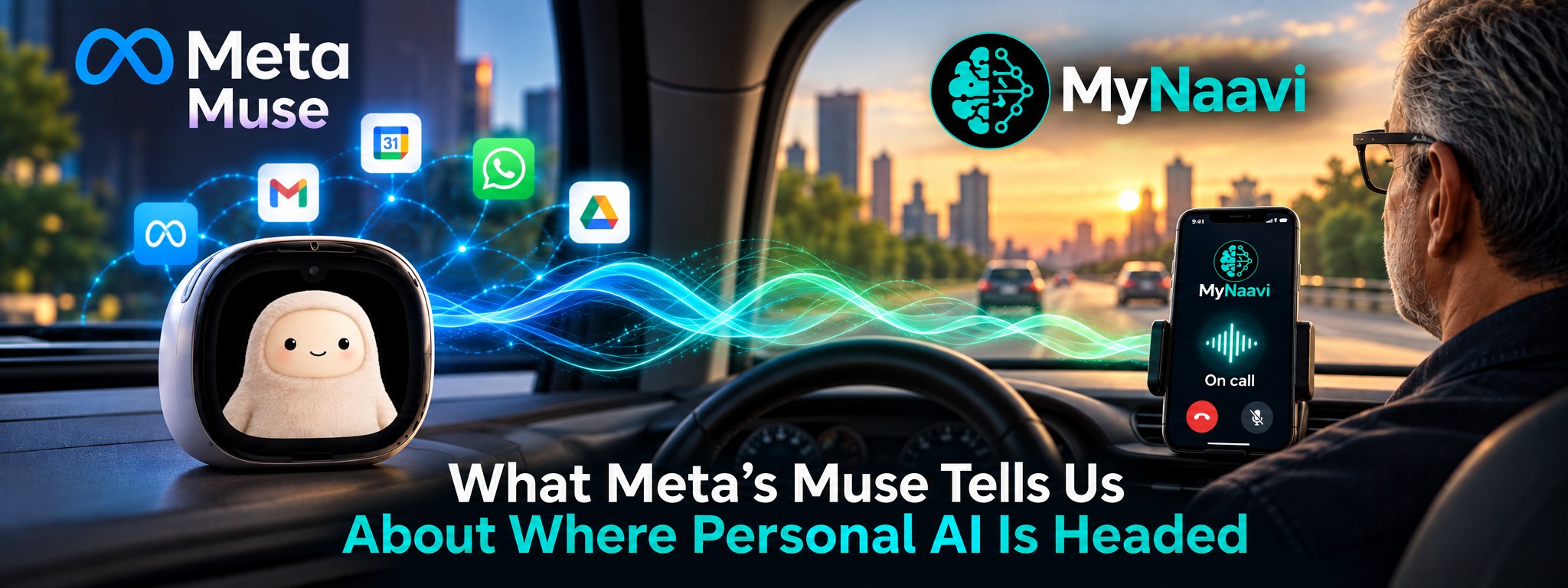
On September 8, Meta introduced Muse, a personal AI agent designed not just to answer questions, but to take action across the apps and services people use every day. Within two weeks it had topped the U.S. app download charts, with more than 2.5 million downloads according to Sensor Tower data. [1]
Then, at Meta Connect, the picture became even more interesting.
Meta announced plans to bring Muse to its AI glasses, more connectors to outside services, and Muse Charm — a pocket-sized device built specifically for talking and interacting with Muse. [2]
This is clearly a serious, well-funded bet on a new category: an AI agent that can sit across a person's digital life and act on their behalf.
I've been building in exactly this space for a while now, on a much smaller scale.
So watching a company with Meta's resources step into it wasn't unsettling so much as clarifying.
What's interesting to me isn't the competition. MyNaavi isn't trying to be Muse, and it isn't sized to be.
What's interesting is the shape of the choices Meta made, because they're some of the same choices we've had to make — and we didn't always land in the same place.
How much of your life should an agent hold?
Muse runs on what Meta calls Muse Secure VM — a dedicated virtual machine containing the agent and the information and credentials needed for the services a person connects.
Meta has put significant engineering into protecting that environment. Users choose which services Muse can access, permissions can distinguish between reading and taking actions, and Meta says Muse data is not shared with its advertising systems. [3]
But the architecture also illustrates something fundamental about personal agents.
To become broadly useful across someone's life, an agent may need access to some very sensitive parts of that life.
Meta's own engineering team described the challenge plainly: building Muse meant handing a piece of software their inboxes, their calendars and a shell, and letting it run unattended. [4]
That is a significant trust relationship, regardless of how good the security architecture is.
With MyNaavi I made a narrower bet, and I want to be exact about what it is, because the easy version of this claim isn't true.
MyNaavi does keep a copy of some of your mail. It syncs your recent messages in the background and stores the subject, the sender, the date and the first part of the text, so the answer is there the moment you ask about a bill or an appointment. Our privacy page has said exactly that since it was written. I'm not going to pretend it's nothing.
The narrower bet is about reach, not about storage.
MyNaavi asks your Google account for a short list: read your mail, send mail when you ask it to, your calendar, your open tasks, your contacts. In Drive it can only see files it created itself — the notes, briefings and lists it saved for you. It cannot open anything else in your Drive.
None of that is mine to define. Google decides what each permission grants, and it shows you every one of them on its own consent screen before you agree to anything. For permissions like reading mail, Google requires a security assessment by an independent third party, repeated every year to keep the access. [5] So none of this rests on my promise: the rule is Google's, and the people who run the check do not work for me.
There's no payment connection. No shopping. No retailer accounts. No health data. No browser it drives on your behalf. Meta is adding Walmart, Best Buy, Sephora, Wayfair, Shop Pay and PayPal to Muse. [2] MyNaavi won't be able to buy you anything, now or later, because that isn't the job I'm building it for.
And there's no advertising business anywhere behind it. Not as a policy that could be revised. There simply isn't one.
So the difference isn't that MyNaavi holds nothing. It's the size of the door. Muse is designed to know enough about you, and to be able to do enough on your behalf, to act broadly across your digital life. MyNaavi is designed around a smaller question: what does it need to reach in order to help you follow through on the things you actually ask it to do?
Those are two different approaches to personal AI. Mine is the easier one to check, and that's most of why I chose it.
How much new infrastructure should personal AI require?
The second difference is about how people reach the agent.
Muse launched through its mobile apps, the web and WhatsApp. Meta is now extending it into AI glasses, additional services and dedicated hardware through Muse Charm. [2]
That makes sense for Meta.
It is building an ecosystem around the agent — multiple devices, interfaces and services through which Muse can remain available throughout someone's day.
MyNaavi started from close to the opposite assumption.
The infrastructure people already have should be enough.
You reach MyNaavi by calling a phone number. Nothing to open first. No screen to watch. No device to buy. You can call from a phone that isn't yours, using your own PIN — and you can switch that off if you'd rather nobody could.
One honest caveat, because it matters: getting set up does take the app, once. You install MyNaavi from Google Play and connect your Google account, because that permission has to come from you and Google requires it to happen there. After that, the phone line is the everyday way in, and most of what MyNaavi does never needs the app again.
That's a much smaller answer than Meta's, from a much smaller company. But I think it's worth having a version of personal AI that doesn't ask you to change how you use your phone before you can begin.
And then there is voice
This may be the part of the Muse announcement that interested me most.
When Muse launched on September 8, Meta described interacting with it much like messaging another person through the Muse app or WhatsApp. [3]
At Connect, Meta introduced Muse Charm, a pocket device built specifically for people to talk with their Muse. And Muse is coming to Meta's AI glasses so people can interact with their agent hands-free while moving through their day. [2]
For MyNaavi, voice wasn't an interface we added later.
On the project's first day, the app asked for the microphone before it asked for anything else. The phone line followed a few weeks after that, ahead of almost everything else we've built since.
The reason is simple, and I wrote about the research behind it in Why MyNaavi Was Voice-First From Day One: many of the things we forget don't occur while we're sitting in front of a computer waiting to type them somewhere.
They occur while we're driving, walking, cooking, moving between meetings, or suddenly remembering something we promised someone earlier.
That's why MyNaavi was voice-first from the beginning.
Not because voice is more impressive technology.
Because of where the problem happens.
Two different bets on the same future
Muse and MyNaavi are obviously operating at completely different scales.
Meta is building a general personal agent with enormous infrastructure behind it, deep integrations, dedicated hardware and potentially billions of users.
MyNaavi is making a much narrower bet.
Use voice first. Use infrastructure people already understand. Hold only the information needed to provide the capabilities we offer. Concentrate on a very ordinary human problem: remembering what needs to happen next and actually following through.
I don't know yet whether that bet is the right one.
A lot of very smart, very well-funded people are building broader systems, and they may be right.
But watching Muse arrive has given me a useful mirror.
It suggests that personal AI is moving beyond the chatbot. It is becoming something that remembers, connects, acts and stays available as people move through their lives.
The interesting question may no longer be whether that kind of personal agent is coming.
The question is what kind of relationship we want to have with it.
And that's a question I think is worth exploring in more than one way.
— Wael
Sources
- Reuters — EXCLUSIVE: Meta testing a 'human concierge' for its new personal AI agent, Muse, Katie Paul, September 22, 2026. reuters.com
- Meta — The Biggest News From Connect 2026, September 24, 2026. about.fb.com
- Meta — Introducing Muse: The World's First Personal AI Agent Built for Everyone, September 8, 2026. about.fb.com
- Meta AI Research — How We Built Safety Into Muse, Tarek Sheasha, September 8, 2026. research.meta.ai
- Google for Developers — Restricted scope verification: "the system must undergo an annual security assessment from an independent, third-party assessor that is approved by Google", and apps "must be reverified for compliance and complete a security assessment at least every 12 months". developers.google.com
Try the phone call yourself.
Call the demo line — 1-888-91-NAAVI — from any phone.
No app, no account, no setup.
MyNaavi is free on Google Play. Install it once, connect your Google account, and after that you can just call.