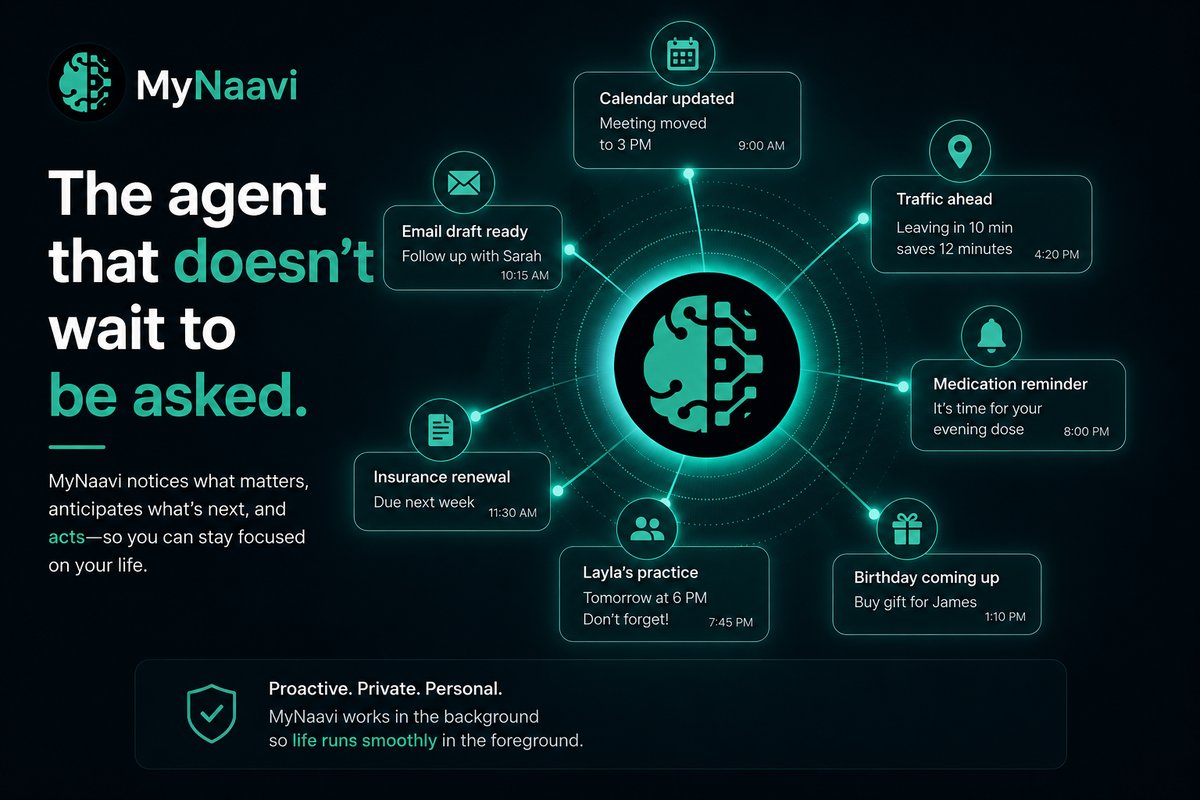
There is a difference between a tool and an agent.
A tool sits on a shelf. You take it down, use it, put it back. It works the same way every time — but it does nothing while it sits there. Your calendar app doesn't notice that you booked two meetings at once.
An agent is on the floor with you. It carries some piece of your intention forward while you're busy with something else. The defining test: does it come back to you, or do you have to come back to it?
By that test, most "AI assistants" are still tools. Very good tools — but they wait. You ask, they answer. Step away, and they stop existing.
MyNaavi is built the other way around. The point is not what happens when you talk to MyNaavi. The point is what happens while you don't.
"The defining test of an agent: does it come back to you, or do you have to come back to it?"
A day in the life — set once, watched always
What follows is one ordinary day. Nothing in it is dramatic. The interesting part is what MyNaavi does in the silences — the things you never asked for in the moment, because you asked once, weeks ago.
MyNaavi finds the appointment letter
A PDF lands in your inbox — a dentist confirmation you won't see for another hour. MyNaavi sees it now: reads the file, pulls out the date and the address, files the original in MyNaavi/Documents/medical/, and adds the appointment to your calendar with a 30-minute travel buffer.
You set this up six weeks ago: "watch my inbox for appointments and put them on the calendar." You haven't thought about it since.
MyNaavi notices the silence
Your daughter usually emails every week or two. It's been twenty-three days. MyNaavi flags it in your Daily Briefing — "Sara hasn't been in touch lately, want me to ping her?" You say yes while pouring coffee. By the 10 a.m. a draft is waiting. Short. Warm. In your voice. You tap send.
You asked once, last year, after the family group chat went quiet: "let me know if I haven't heard from Sara in a while." MyNaavi has been watching ever since.
MyNaavi handles the renewal
Your car insurance renewal came in this morning with a 6% increase. MyNaavi reads it, compares it to last year's policy in MyNaavi/Documents/notice/, and has it ready for you: "Insurance is up 6% — last year's broker quote is in your Drive if you want to call them."
You set this one up in a single sentence last renewal season: "watch my inbox for the insurance renewal and tell me if the price moves." You have not thought about it since.
MyNaavi adjusts the travel time
Your 3:30 is across town, and there's an accident on the route Maps usually picks. MyNaavi sees it as you walk out of your last meeting and pings: "Leave in eight minutes for the Northcote meeting — traffic added twelve minutes to the usual drive."
You didn't ask how traffic was. The decision arrived with the answer already inside it. Eight minutes. Go.
MyNaavi brings the list
Two weeks ago you said "add eggs and a roast chicken to my Costco list." Yesterday in the car, "add laundry detergent." This morning your husband said "don't forget the school t-shirts."
You haven't looked at the list once. As you pull into the parking lot your phone buzzes — "At Costco. 4 items on your list." One tap, and they're in front of you.
MyNaavi sends the thank-you
Three days ago a colleague covered a meeting on short notice while your kid was sick. Somewhere between the airport and home you said "remind me to thank David next week." MyNaavi waited. Today is the right day, and the draft is ready when you sit down — your tone, his name, one line about what he did.
You didn't carry the obligation all week. MyNaavi did, and gave it back at the moment it would land best.
What an agent actually does
Look at the six again. Notice what they share.
You set the intention once. Sometimes months ago, in a single sentence on a drive home. Sometimes never explicitly — MyNaavi inferred it from the way you live.
The world changed. An email arrived. Traffic shifted. A silence stretched. A list filled up. None of it required a query from you.
MyNaavi decided whether to act, and how. Not every email becomes a calendar entry; not every quiet stretch becomes a draft. Some become actions, some a line in your Daily Briefing, some are filed for later. That judgment is what makes it an agent rather than a script.
You got the right thing at the right time. Not "here are 47 notifications from today." One sentence, in the moment it mattered, with the decision already made.
Why this works
Three reasons, and they compound.
The bottleneck in most lives is not the capacity to do work. It is the capacity to notice when work needs doing. Dropped balls are rarely dropped because you couldn't lift them — they drop because nobody was watching the corners while you focused on the centre.
Intention is sticky in a way tools have never been able to use. When you say "watch my inbox for appointments" on a Wednesday in March, you mean it forever. You shouldn't have to renew the instruction every month.
And decisions are easier one at a time, with the context already attached. "Leave in eight minutes — traffic added twelve to the drive" is a single choice: go, or push the meeting. The route comparison and the math were MyNaavi's. You just choose.
The shift from tool to companion
An agent that watches and acts on your behalf isn't a better chatbot. It is a different category of thing entirely.
You don't have to remember to ask. You tell MyNaavi once, the way you'd tell a thoughtful colleague, and trust that it carries forward. What drops is the mental tax of "remember to remember" — not because you got more disciplined, but because someone else is holding the corners.
It changes the relationship. A tool is something you use. A companion is something you rely on. MyNaavi is built to earn the second word, every day, in the small ways that compound.
That's the whole bet. Not better answers. Fewer questions you had to ask in the first place.
Set it once. Let MyNaavi watch the corners.
Call the demo line — 1-888-91-NAAVI — from any phone.
No app, no account, no setup.
MyNaavi is free on Google Play. Install it, tell it one thing you'd want followed on your behalf, and see what it does with it.