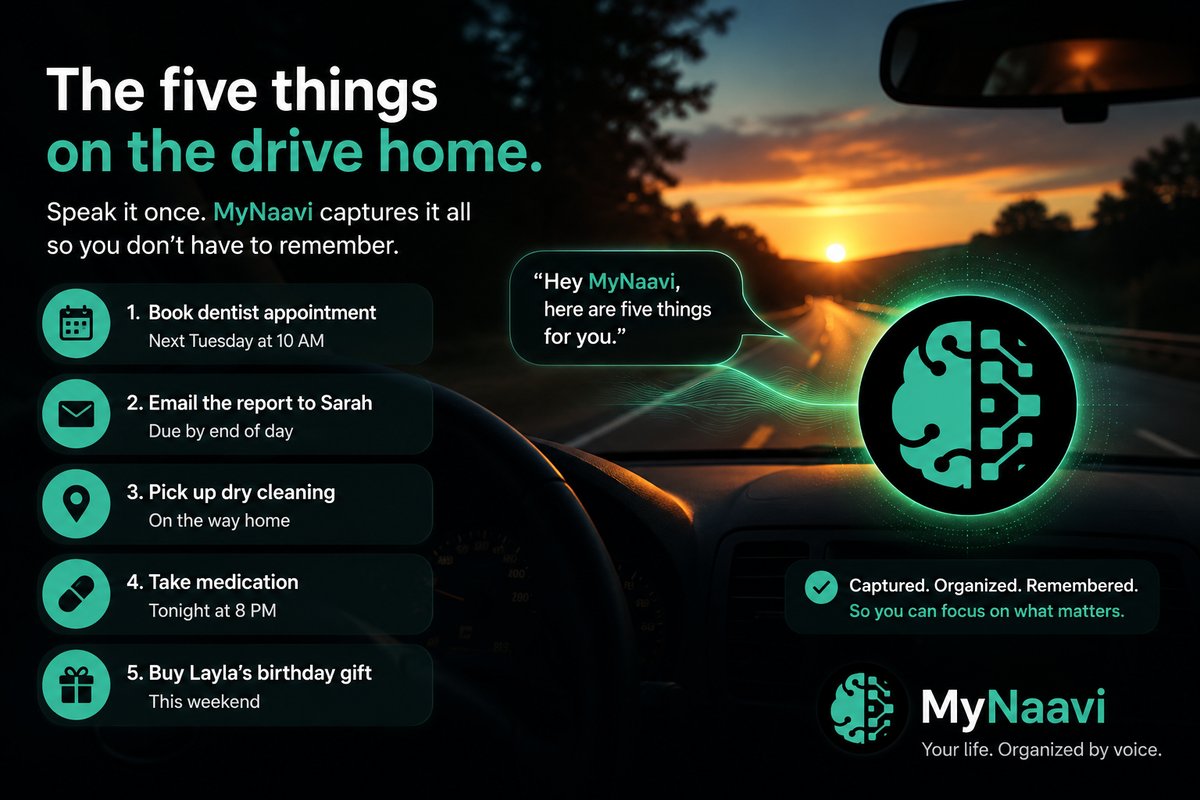
You're driving home from a meeting and things start piling up. The route is familiar enough that some part of your brain is free to do other work. And that other work is what comes for you, every time.
Email Sarah the Q4 budget by Friday. Pick up Layla from hockey at six on Tuesday. The Toronto client follow-up next week. Maria's birthday gift before the weekend. Pricing strategy for Monday's meeting. Five things. They arrived in the same forty seconds.
You used to write them down. Then phones happened, and you typed them. Then notes apps multiplied, and you split them across three or four. Now most of them stay in your head until you can get home and find a keyboard. And by the time you get home, two have evaporated.
The problem is not capture
The common diagnosis is that you need a better notes app. Or a stylus. Or a wearable that listens. Or — depressingly often — a fresh attempt to write things down on paper. Capture, capture, capture.
But the bottleneck is not capture. The bottleneck is the round-trip. You can write a thing down in three seconds. Finding it again, at the moment it matters, takes thirty. Multiplied by five items and a forty-eight-hour delay, that is the entire reason your weekend is full of low-grade dread.
"The list you carry in your head is not a memory problem. It's a retrieval problem the world has not yet solved."
Apps that solve capture have proliferated for fifteen years. There are a thousand ways to write a thing down. There is still no way to ask, in the middle of a Friday afternoon at the mall — out loud, without unlocking anything — what was the Maria thing again? and get the answer in the time it takes to walk to the next store.
What changes when items file themselves
Say each of the five things, out loud, on the drive home. Don't choose categories. Don't pick which app. Don't try to be tidy.
Naavi, record my thoughts. Email Sarah the Q4 budget by Friday. Layla, hockey, Tuesday at six. Toronto client follow-up next week. Maria's gift before the weekend. Pricing strategy for Monday.
By the time you reach the driveway, every item is filed where it belongs. Sarah's note is drafted and queued for your approval. Layla's pickup is on the calendar with a reminder. The Toronto follow-up is in your CRM-shaped corner of Drive, tagged for next week. Maria's gift is on a list that will surface itself on Thursday. Pricing strategy is in your work notes folder, ready when you sit down Monday morning.
You didn't pick destinations. You didn't open anything. You didn't try to be organized. You just said the things out loud, the way you thought them.
The round-trip closes
Friday afternoon, you're at a mall parking lot, and your phone rings.
Naavi: Don't forget Maria's birthday gift.
That's it. That's the whole interaction. No app to open, no list to scroll, no search to run. The thing you cared about on Tuesday came back to you on Friday, in the right place, at the right time, in one sentence.
Two days later, you ask, out loud — Naavi, what's coming up this week? — and the answer comes in one breath. Work and life held side by side, as they actually live in your head. Not as five separate apps would have them.
What the drive home reveals
The drive home is a small thing. But it is the canary in your mental coal mine. If five things pile up there and don't get caught, they pile up everywhere else too — in the kitchen, in the shower, in the moments between meetings.
The list you carry in your head is not a deficit. It is a sign that you care about more than any single tool can hold. The fix is not to care less. The fix is to put the caring down somewhere it will come back to you when it should — and stay quiet until then.
You don't forget because you don't care. You forget because life is full. The right system holds the fullness on your behalf.
Try it on your next drive home.
Call the demo line — 1-888-91-NAAVI — from any phone.
No app, no account, no setup.
MyNaavi is free on Google Play.