More calendars. More reminder apps. More lists, in more places. Each one was good at its job. Together they created a new job: managing the tools. I was spending my time feeding software instead of living my life, and the complexity I was trying to remove had simply moved somewhere else.
Two things came out of that, and only one of them was about me.
The first was personal. Forgetting things made me feel I was losing my grip — my memory, my sharpness, my ability to stay on top of my own life. That is a bad feeling at any age, and it is worse when you have built your career on being the person who handles complexity.
The second mattered more. The people around me started to read those forgotten things as not caring. A missed birthday. A follow-up that never came. An appointment I had promised to arrange.
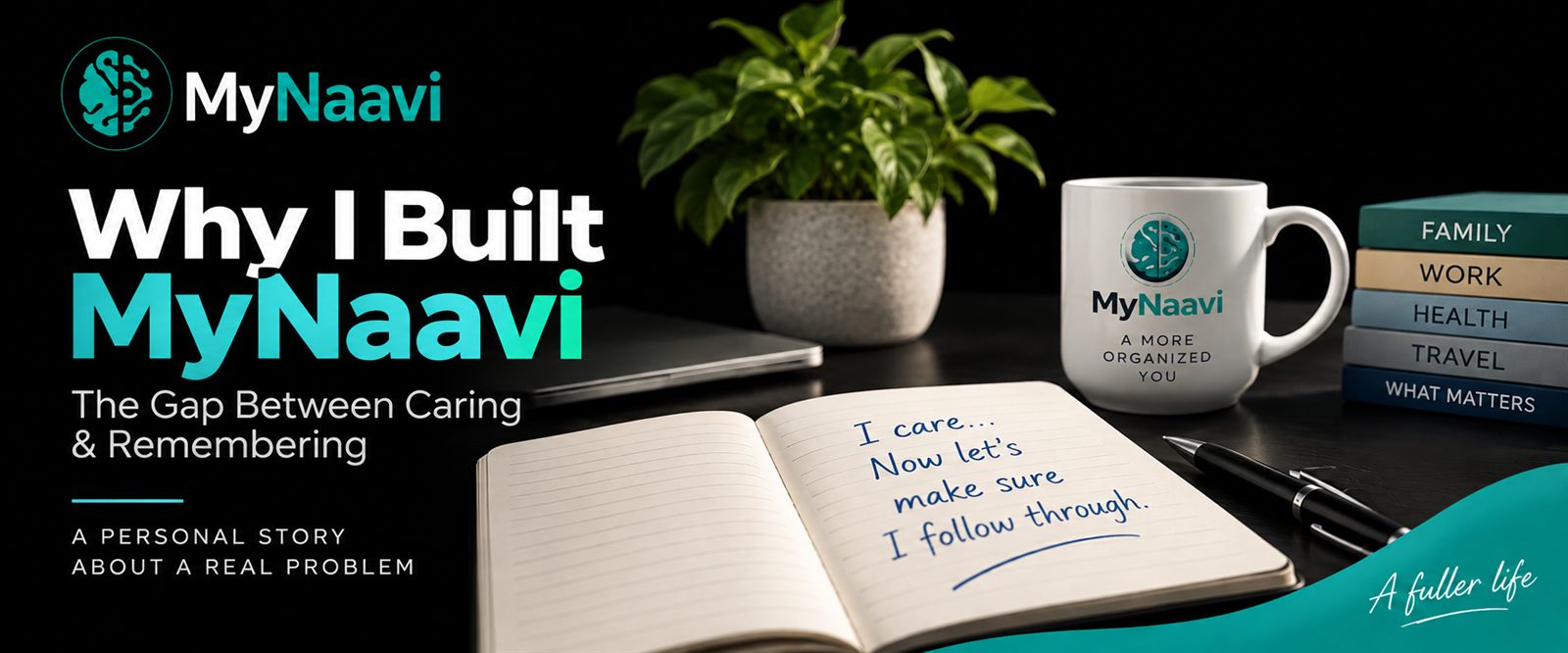
But I did care. I cared about my grandkids’ birthdays, about my health, about the people waiting on me. If anything, I was carrying more of it in my head than ever. What failed was not the caring. It was the follow-through.
For a while I assumed this was my problem to solve on my own. Then I started mentioning it to friends and colleagues, and heard the same sentence back, almost word for word:
“They think I no longer care. I do care. Life has just become more complex.”
That changed everything for me. It was not a personal failing. It was a shared condition, and nobody had built for it.
So I went back to my toolbox
I had been following what AI could do, and like everyone else, I was impressed. Surely this was the answer.
It was not — not as it comes. I tried the assistants. They can answer almost anything, write almost anything, reason through almost anything. Genuinely remarkable, and genuinely not built for my problem.
Ask a general AI a question and you get an answer about the world. What I needed was something that understood my world: my people, my places, my calendar, the thing I promised my daughter on Tuesday. And I needed it to actually do those things, reliably, every time — not to produce a plausible answer about them.
There is a real technical difference underneath all this. I set it out in three articles I wrote after starting MyNaavi, to put the thinking behind the company on the record:
- Why AI Gives a Different Answer Each Time — why these systems are probabilistic by design.
- Why More AI Capability Doesn’t Mean Less Work — why more powerful tools can still leave you doing the work.
- AI Orchestration vs. Generic AI — what has to sit around an AI for it to be depended on.
The short version: generative AI is brilliant at understanding what you mean, and it guesses. Guessing is fine when it is drafting a paragraph. It is not fine when it is messaging your wife or moving a medical appointment.
What MyNaavi does with that
MyNaavi uses AI for the part AI is genuinely best at — understanding what a person means when they say it naturally, mid-drive, mid-conversation, mid-life.
Then it stops guessing. A deterministic layer takes that understanding and carries it out against your real contacts, your real calendar and your real places, and it confirms with you before it creates, changes or sends anything. Say it once, and MyNaavi handles the follow-through: the reminder, the message to someone else, the calendar entry, the thing that needs to happen when you arrive somewhere.
You can talk to it in the app, or just call it on the phone like a person.
What failed was never the caring. It was the follow-through.
The point
I did not build MyNaavi because AI is exciting. I built it because I was tired of the gap between caring about something and remembering to do it — and because I learned I was far from alone in that.
The goal is not to make you more productive. It is to make sure the things you actually care about do not quietly fall through, and that the people in your life never have to wonder whether you stopped caring.
— Wael Aggan, Founder, MyNaavi